
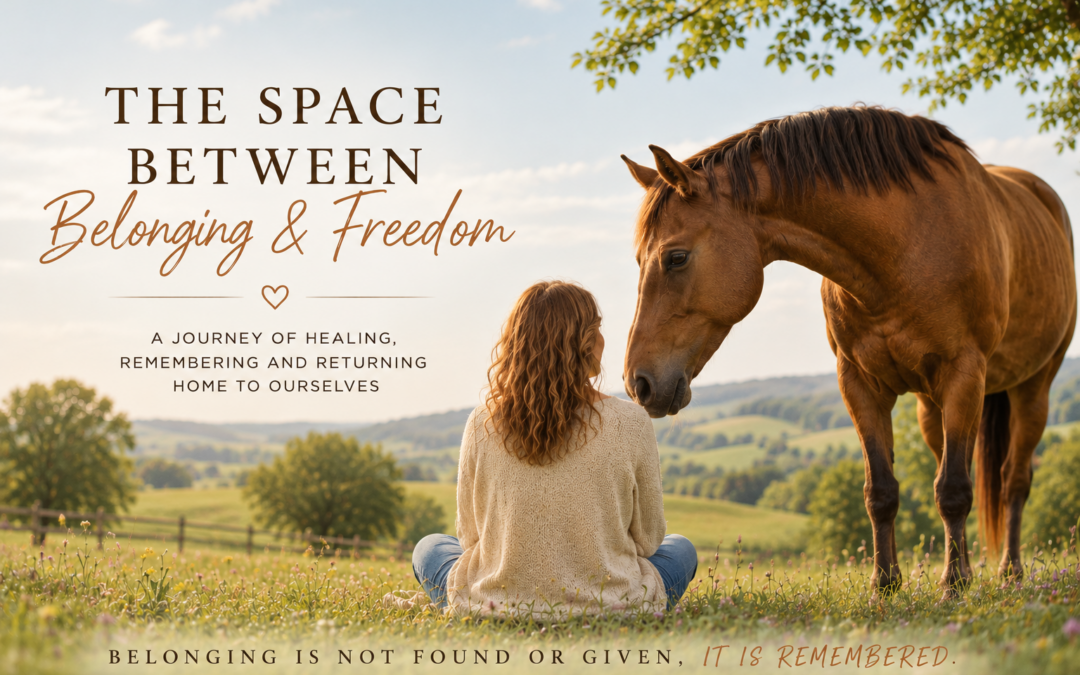
Looking back, it seems there has always been a conversation between freedom and belonging running quietly beneath my life. It has taken me sixty-three years to realise how deeply these two forces shaped my life.
At the time, of course, I had no idea.
Life simply felt like a series of choices, relationships, successes, countries, disappointments and opportunities. It is only in hindsight that the thread becomes visible, weaving itself through experiences that once seemed unrelated. Only then does the picture begin to emerge. I rarely recognised the deeper pattern while I was living it. It is only when I stop long enough to look back in astonishment, and begin to wonder what has been guiding me all along. Something that feels much older. Something that is part of the very fabric we are made of.
I was born in 1963 into a generation of women whose lives looked very different from those of our mothers. Growing up in what was then West Germany, I enjoyed freedoms that no previous generation of women had known. Education, financial independence, meaningful careers, political strength and the ability to choose whether or not to have children became part of what we took for granted. We were encouraged to become autonomous, to shape our own futures and define ourselves by our choices rather than by societal norms and the expectations of others. I became an active participant in dismantling traditional expectations of women and imagining new possibilities for who we could become. There was no roadmap.
As I was growing up in Germany, still in collective post war trauma, the connection with our past was discouraged. Yes, there was a lot of education, very deep reflection and critical thought was nurtured. The way it landed with me as a child was simply: Do not ever become like your parents. You must develop your own perspectives. Do not identify as German with national pride, find your individual truth. Of course, this happened while we were still an occupied country and took it was totally normal to see foreign US soldiers stationed in the neighbourhood and placing cold war Pershing rockets in our forests.
It was an extraordinary time to grow up.
Looking back now, I sometimes wonder whether every generation receives both a gift and a challenge. Ours learned personal autonomy well. We learned to value independence, self-determination and personal freedom. We became fluent in the language of individuality. Only much later did I notice what I didn’t give space. I was so busy to obtain personal freedom and independence that I quietly neglected something just as fundamental.
Belonging.
Not belonging in the social sense of fitting in or finding our tribe, but something much deeper. The unquestioned knowing that we have a place. That we are connected not only to our family or society, but also to those who came before us. That our place in life does not need to be earned because it has always existed.
Perhaps belonging is our most fundamental human need. It allows us to feel connected, safe and part of something larger than ourselves. My own story begins long before I was born.
My parents survived the Second World War and fled Poland because they were of German descent. They left their extended family behind and arrived in Germany carrying what so many families of that generation carried: fear, loss, grief and the unwavering determination to survive. They belonged to a generation for whom silence was often the only possible language. There were stories that could not be told and wounds that could not be touched. Roof over the head and food on the table without prosecution were pretty much the hallmarks of a good life. There was little time or money for conversation about mental health or seeking help for a volatile family life. There was only survival by fitting in.
This was the family I grew up in and, as I only understood more deeply after coming to a grinding hold, formed my guiding life principles.
There is a German word that I remembered recently, I only heard it used by my parents, and I began to see it in a new light: heimatlos.
It doesn’t really mean homeless, in its meaning it is best understood as “without a homeland”, which is more subtle. It speaks of being without a place of belonging.
I was always struck by the severity the word carried in their voices.
As I have become older, I find myself wondering whether that experience leaves traces that extend beyond those who first lived it. Whether families carry not only memories but also ways of relating to the world and those around us.
Comparing my own opportunities with those of my mother, we might as well have lived in different centuries, on different planets. Even compared with my sister, who is twelve years older than I am and arrived in Germany as a young five-year-old refugee, my world was profoundly different. I didn’t need to experience the struggle of profound change, rejection and adjustment. I didn’t flee from my country of origin to go to my “heimatland” only to discover that I was regarded as a stranger and often worse. I drew breath in the country. I had the right accent. The right name. The right birth certificate. The right skin colour. As far as I knew, I belonged. I was just somewhat different to my family.
Yet belonging and feeling that we belong are not always the same thing.
It has become one of my life’s quiet ironies that my deepest needs often disguise themselves as my greatest strengths.
The longing to belong can wear many masks. It called itself ambition, financial independence, success, mobility, personal growth and freedom. From the outside these qualities are admired. We reward them in ourselves and celebrate them in others.
I certainly did.
If someone had asked me what mattered most for much of my life, I would have answered without hesitation: freedom. Freedom to choose. Freedom to leave.
Freedom to make my own decisions.
And I was good at it. Today, I am very grateful for everything I experienced no matter how difficult it was. Even the experiences that seemed meaningless or destructive shaped the person I became.
Only recently have I begun to ask whether my devotion to freedom was entirely what I believed it to be.
What if autonomy was not only a value?
What if it had also become a protection?
This question did not arise because I suddenly became more insightful. If anything, my mind had always been exceptionally good at making sense of my life and helped to achieve many of my goals. It analysed, compared, reflected and understood. Looking back now, I can also see how skilfully it protected me from feeling things that lay beyond its reach.
After a first health challenge during my late thirties something shifted. I chose work over university. Financial independence mattered more than anything else. Somehow I found myself immersed in the world of blue-chip corporate sales and marketing, studying in evenings and week-ends while building my career. I was so focused on success and performance that I didn’t even notice my health and that my marriage literally disintegrated. I was horrified to find myself in a moment where I realised “I am living my mother’s life”. The one thing that was the relentless driving force behind everything I did. It stopped me cold. I had spent years running from that possibility, to escape my childhood blue print and suddenly it felt as though I had arrived exactly where I never wanted to be.
Time for action. And I am good at action. The search for purpose and meaning began, and I can make things happen. I left corporate life and trained as counsellor. I was determined to do something more meaningful than achieving revenue targets. At the same time, I started my own consulting business. Ironically it gave me even more autonomy, even longer working hours and even more pressure.
For more than twenty years I immersed myself in understanding human relationships – in families, partnerships, organisations and across cultures as an expat. Along the way I rediscovered my passion for theatre, which reawakened my creative part that had been waiting in the wings. I rediscovered my passion for acting. Each move opened another window. Each brought new challenges. My life changed in meaningful ways.
Yet one part of my life seemed curiously untouched.
Relationships.
Looking back across the years, the pattern is difficult to ignore. Every significant relationship remained child-free by my own choice and ended in painful separation. Gradually I realised that I consistently chose emotionally unavailable partners. Some had different priorities. Others simply did not share a compatible vision for the kind of partnership I longed for. Yet I worked harder and harder to build self-sufficiency and independence. Everytime I learned the lesson: “If I get too close, I risk losing myself. I’ll get hurt. Better to stay independent.”
I understood the pattern. My mind could analyse it, define it.
I simply couldn’t shift it.
Eventually life did what it so often does when we have exhausted every intellectual explanation.
It brought me to a complete stop.
Burnout arrived not as an inconvenience but as a collapse. My body began speaking a language my mind could no longer explain away. Autoimmune symptoms appeared and, frightened for the first time, I finally stopped doing what had always come so naturally.
I stopped striving.
I stopped over-working.
I stopped fixing things.
And gradually I stopped running from myself.
As the relentless rhythm of my life fell away, my attention slowly turned inwards. At first there was unstoppable tears, never-ending joint and muscle pain, sleepless nights, an unfamiliar heaviness in the pit of my stomach. I felt a loss of identity and overwhelmed by depression and profound anxiety. I sat with it for months.
As soon as I could, I threw myself into studying something new – anything that meant I didn’t have to sit still. I qualified as an end-of-life pet doula and celebrant. I felt the irresistible pull towards grief, death and support bereaved pet owners. Looking back now, I wonder whether the deepest sense of belonging I had ever truly trusted was the bond I shared with my dog Cobber. Perhaps I wanted to honor what Cobber had given me by accompanying other through this experience. Slowly, almost like a shadow emerging from beneath the surface, it became clearer.
The feeling wasn’t loneliness.
It was aloneness.
There is a difference. Loneliness longs for company. Aloneness speaks of something much deeper. It felt strangely unfamiliar, as though I had encountered a part of myself that had always been there but had never before been given permission to speak.
That discovery began another journey.
I continued exploring the patterns that had shaped my family and my life. Layers gradually revealed themselves. Again and again something hidden became visible. Yet despite all the insight and all the movement, this deep sense of aloneness remained.
One systemic constellation I did brought the issue into extraordinary clarity. And yet again, I simply couldn’t shift it. Not all of it.
Then another deeply painful experience in relationship brought everything into sharp focus. What struck me wasn’t the event itself but my emotional and physical response to it. The intensity of the reaction was wildly disproportionate to what had happened. Instead of trying to explain it, I decided it was time to really, really look at it.
What was my body trying to show me?
Over time, a sentence quietly emerged.
I had organised my life around autonomy and personal freedom.
Whenever I moved towards a relationship that stirred a genuine longing to belong, I somehow found myself with someone with whom that longing could never be safely fulfilled.
Looking back I can now see how perfectly, albeit unconsciously, this protected me.
My anger was aimed at the other person. I never looked in the mirror to see the sadness and grief sitting deep underneath.
If you truly belong, you will lose yourself and get hurt.
The words seemed almost too simple.
Then, one morning, another question appeared.
What is it that I would most love to move towards and, at the same time, be deeply afraid of?
The answer arrived immediately with a decent degree of surprise.
The horse.
I have loved animals for as long as I can remember, and horses have always held a particular fascination for me. Their size commands respect, their beauty and grace are stunning, yet there is also something deeply gentle about them. More than anything, I have always sensed that they perceive us differently from the way humans do. They seem to respond less to what we say than to what we are. Long before I became interested in systemic constellation work, I trusted that animals often knew something about us that we ourselves had not yet recognised. I learned that from my dog Cobber, the love of my life and teacher of unconditional love.
So I followed a friends’ recommendation and booked two days of equine-assisted therapy with the incredible therapist and equestrian Eloise Lamond (essencewithin.com.au) on her beautiful property in Kangaruh Valley.
Away from everything.
I arrived with equal measures of curiosity and apprehension. By then I had articulated the question I wanted to explore. It seemed simple enough.
How could I long so deeply for belonging and, at the very same time, fear it? And, although my mind understood the reasons after intense analysis and therapy, why couldn’t I shift it? What was I still protecting?
I arrived with equal measures of expectation and apprehension. The property was immersed in nature, surrounded by open paddocks. There was a stillness and beauty about the place that seemed to let me breathe a little deeper. I started to settle and felt myself to slow down. I quiet surrender to what was to come. The therapist listened carefully and began shaping experiences around the question I brought with me. She understood horses intimately, but just as importantly she understood people. She listened carefully and then, without forcing anything, began shaping experiences around the question I had brought with me. There was no agenda beyond remaining present to whatever emerged.
Meeting the two horses, Mary and May, was, well, profound. The very first encounter guided by the therapist revealed the first deep insight. Typical me, I turned up ready for action, doing things. No. We just stood there. In their time, Mary and May came over and we just stood there. “They came to connect” the therapist said “They don’t expect anything from you. They just want to connect. There is nothing to do. They know what’s going on inside you and you express congruency. If there is friction, they walk. Can you be here with them and connect?” Let’s say it wasn’t easy. Inside me, everything became a whirlwind. It took a lot of breathing techniques to ground me and be present. Over the two days, the horses became extraordinary mirrors. They responded with complete honesty to my inner state, revealing every moment of incongruence with remarkable precision. There was no hiding. Staying present was challenging to say the least. There were moments when connection felt effortless and deeply moving, followed almost immediately by moments when everything dissolved. We explored when closeness changed from comfort to sensing danger. We tested personal boundaries in spatial representations. One horse nipped my leg after being beautifully close and reassuring. “This is what it is like”, I burst out. “It’s always like that.” I remember feeling almost childlike in my frustration, walking away and stomping around in the paddock, wanting to abandon the whole process, throwing a tantrum, scold myself for the silly idea, get into my car and drive home.
Looking back now, I smile. The horses were doing exactly what I had come for. They were showing me the places where my inner world and my outer actions were not aligned and they were showing me the constant pull between “do I stay or do I go?”.
Somewhere during the second day the therapist paused for a moment and quietly suggested something different.
Would I choose two objects and place them in the paddock.
One could represent my longing for belonging, the other one my autonomy.
There was nothing unusual about the invitation. Placing objects to externalise something internal is common in many therapeutic approaches and at the core of constellation work. Yet as I began walking around looking for them, something inside me became unexpectedly alert.
I know this feeling.
I recognised the quiet shift that sometimes happens at the beginning of a constellation. The atmosphere seemed to change almost imperceptibly. Attention became softer. My own thinking receded into the background while something else gently came forward.
What I do know is that from that moment onwards everything seemed to unfold with its own quiet logic.
When I stood in the place representing belonging, my knees weakened almost immediately. A sensation I remember well from my early childhood and parent relationship challenges. My body wanted to move backwards. There was a palpable sense of vulnerability, almost as though belonging itself required something of me that I was unable to give.
Then I walked across to the place representing autonomy.
There everything changed.
I stood tall. Calm. Grounded. Powerfull.
My breathing settled and my awareness expanded. From there I could see everything around me. There was strength in that place. Safety.
As I moved between the two positions, one thing became obvious. There was no relationship between them. It felt as if they existed as separate worlds.
The therapist then gently brought one of the horses into the paddock.
It wandered between the two places with complete freedom, pausing briefly at each before eventually coming to rest exactly between them.
It simply stood there. Still. Relaxed. Entirely at ease.
My first thought was immediate. I saw it as the stuckness between the two.
But as we remained there together a little longer in silence, something shifted. The longer I looked, the less that interpretation made sense.
The horse wasn’t showing me conflict.
It was showing me balance.
Standing between belonging and autonomy, it seemed to hold both with equal dignity, as though neither needed to dominate the other. The image was so simple, yet it landed somewhere beyond words.
I am not either/or. I have both and they keep me balanced.
It had never occurred to me that belonging and autonomy might not be opposing forces. I had lived as though every movement towards one required a sacrifice of the other. Yet here, without explanation, stood a picture that suggested something entirely different.
Perhaps they belong together.
Perhaps each gives meaning to the other.
That image alone would have been enough.
Yet something else was still unfolding as the place that represented “need for belonging” was unstable and weak.
Following an impulse that seemed to arise without conscious thought, I gathered several more objects and placed them to represent me and four generations behind me in one straight line.
Up until then there had been no discussion about family. No intention to create a constellation.
And yet there it was. Almost without thinking, I heard myself ask aloud, “Where does this issue belong?” Afterwards the therapist told me that my voice sounded different.
“It was as though the words came out of your bones,” she said. I knew exactly what she meant.
Until then the second horse had been standing quietly at the far end of the paddock throughout all of this. It had shown no interest in what we were doing.
Slowly, and entirely of its own accord, it began walking towards us.
Neither of us moved. We just watched.
The horse simply approached the line of generations and began making its way along it. At each object it paused. Sometimes it lowered its head and sniffed. Sometimes it gently nudged an object with its nose. Occasionally it picked one up before quietly placing it down again. It gave each generation its own attention.
There was no hurry. Eventually it reached the final object and continued walking until it stood at the fence beyond the line, looking out into the distance.
Nothing needed interpreting. The image carried its own meaning.
For me it spoke of something very old, much older than my lifetime.
As a constellation facilitator I have come to recognise experiences like this in many different forms. Whether we understand them through family history, intergenerational trauma, epigenetics, quantum physics or the systemic lens itself matters less to me now than the quiet recognition that our lives rarely begin with us alone.
Standing there with the horses, I experienced that truth in a way that no explanation could ever have achieved. There are burdens that do not belong to us.
The fence itself felt significant. Almost like an acknowledgement that there are boundaries we are not meant to cross. At least not yet.
I acknowledging what was not mine to carry and returned it, with respect, to where it belonged. Only then, finally, did the tears come.
Simply a release that felt as though it had waited a very long time.
When it was over, both horses quietly wandered away into the paddock. Their work was done.
As I drove home I found myself thinking about the horses and about what had happened between us all. The therapist had followed her intuition. I had followed mine. The horses had responded as horses do, without agenda or interpretation. Yet together something had emerged and unfolded in, what felt like a guided way. I have reflected on that often in the weeks since.
Again and again I have experienced those moments when the field seems to take over and brings our awareness to a specific situation. Images emerge that nobody could have predicted. Something hidden quietly becomes visible, and with it comes the possibility of movement.
This felt remarkably similar. Not because the horses became representatives in the way people do within a constellation, but because the process itself seemed to invite a constellation into being. It was as though equine-assisted therapy created exactly the conditions in which a systemic image could reveal itself. Without any words or storytelling. Nothing other than presence, acknowledgment and following our inner guidance was needed.
Or perhaps, as I wonder now, the constellation field simply guided us all. I no longer feel the need to answer that question. Some experiences are diminished by too much explanation.
It has only been a short time since those two extraordinary days. My body still feels as though it is quietly reorganising itself. Strange dreams have come and gone. I have learned to welcome them rather than analyse them. Rest, gentle movement and time in nature seem to support whatever continues to unfold beneath conscious awareness.
I do not know how my future relationships will evolve. That is no longer the question that occupies me. Instead I find myself returning, again and again, to the image of that first horse standing peacefully between belonging and freedom.
Perhaps the deepest insight was not that I had finally found belonging. In the beautiful words of the therapist: Belonging is not found or given, it is remembered.
It was the emotional, mental, physical discovery that belonging doesn’t ask me to surrender my autonomy.
And perhaps healing, more often than we realise, begins in the quiet moment when we stop trying to direct the process and allow ourselves to be gently guided by what is already waiting to emerge.